Creativity and Human Connectivity
August 18, 2023
As I headed toward the airport exit, I was eager to vacate with haste to get on with my trip, until I saw a little boy, nine-years-old perhaps. I slowed my pace as I watched this Asian boy, wearing a simple black T-shirt and had a plain, short haircut. I did not see an adult with him, but instead a full-size keyboard on a stand accompanied him. I slowly continued toward the exit. The doors were so close, and daylight was just beyond. But he started playing and I stopped.
A crowd gathered to listen. He played a classic piece, complex and elaborate. The vigor with which he moved his fingers, performing an intricate and eloquent song, it filled the space and lifted your spirit. The magnanimity of the sound was like that of an orchestra, and yet it was produced from a single, little boy. We didn’t just listen. We were engaged with him.
Watching him play the piece, you saw his soul, expressed and manifested in a way that you could feel. His passion and emotions flowed from his face, over his shoulders and through his fingers. He felt the song. As much as our mouths were silent for our ears to listen, our eyes were engaged with this boy’s spirit dancing through the notes.
Humans connect to one another through the creative arts. Artists bear their souls when they create. Ideas, views, and beliefs are shared through an experiential medium. Paintings, films, novels, and songs are centerpieces that draw artist and audience together for a dialogue. We are moved by another human being by painting and music he/she produces. We consider the greatest praises and victories as well as share in the deepest troubles and pain through a good story portrayed on pages or on screen. One of the essential values of creativity is the human connectivity it facilitates. And that connectivity is essential to being human.
Seeing an actor perform brilliantly we don’t see acting but real emotions and real expressions. The acting becomes a medium for us to connect with the mind of the actor who brings a character to life. Seeing a captivating art piece on display, we experience an artist who bears his or her soul on the canvas, paper, or mixed media. Listening to a vocalist sing a classic piece with authenticity and emotion, we can be so moved and brought to tears. When we view a film that sparks an internal dialogue within ourselves and with friends, the filmmaker drew us into a conversation. When we immerse in a novel, we enter a world fashioned from the author’s mind and experience the principles, values, and claims of that world in a felt way. The creative arts are a media for minds to engage one another. The artist puts his creative work out in the world for others to experience, and if we’re engaged with the work, we’re not merely experiencing the tangible object but also connecting with the intangible mind of its maker.
A unique quality of art in connecting people is, unlike expositions and explanations, art provides an aesthetic engagement. You can see, feel, and taste what’s in the mind of the artist. We experience an artist’s thoughts and views in visceral, emotional, and empathetic ways. And it doesn’t only connect us to the artist, but also to one another. Experiencing the same creative work can evoke deep conversations over an important subject because we all saw and felt the same visceral views. We were in the same world together for two hours. We journeyed with the same characters from beginning to end. It is like when we come out of a theater and we don’t want to go home afterwards and go straight to bed, but we want to head to a diner and talk for an hour over shakes about what we all just experienced.
Creativity is vital to human culture because it offers human connectivity. Creativity is more than achieving a decorative a piece of work. Creativity nurtures an aspect of humanity that our souls were designed for – human connectivity. The arts are meant for souls to connect.
One could even say that years later, we can still experience the minds of Michelangelo through the Sistine Chapel, Tolkien through the journey of The Lord of the Rings, Charles Dickens in the world of A Tale of Two Cities, and Handel in the song of Handel’s Messiah.
When human creativity is devoid, there runs the risk of sparse connections between minds in aesthetically felt ways. Diminishing human connectivity starves the soul. So, is creativity vital? Yes. Because it is human. A culture fruitful with creativity offers a sandbox of human connections on meaningfully soulish levels.
Art and Being Human: Insights from Mondrian
August 7, 2023
“What is art?” regains new fire in the heated debate over AI generated images. Can AI art be called “art?” Are there any consequences to accepting machine made images as art? A person enters several words in an AI generator and the AI generates an image within seconds. The AI will “learn” the more it is used and will continue to revise the image to the user’s preferences when new prompt words are entered. Some of the AI generated images I’ve seen look pretty cool, I admit. But is it art? Why is this question important? I find some answers from looking back a hundred years at a radical art movement, De Stijl, of which Piet Mondrian was at the helm. From his work, I’ll discuss two insights on the meaning of art and how they refresh the beauty of being human.
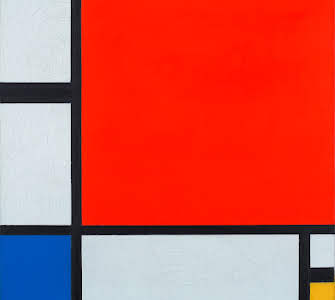
Mondrian was radical for bringing abstractionism to a new height of abstraction, simplifying his paintings to basic straight lines, geometric shapes, and primary colors. During his time, many would’ve even debated whether the subject of his works could be considered art. But like his famous piece, Composition in Red, Blue, and Yellow (1930), the simplicity of form magnifies the complexity of essence in art. When you see his work, it is easy to gloss over it because you see nothing other than perfectly straight, black vertical and horizontal lines forming different size rectangles and squares. Only three of the boxes are colored, one in red, another in blue, and the other in yellow – primary colors. The other squares are plain white. So, what of it?
Mondrian painted many of the perfectly straight lines that look like taut ropes by free hand, while he also incorporated the use of a ruler for other lines. I don’t know if you ever tried drawing a perfectly straight line across a large surface. It is quite difficult to do. I have observed fellow artists drawing or painting lines, circles, and strokes with such incredible precision without the use of an undo button. It requires physically a steady hand, controlled breathing, a focused eye, and an unwavering concentration of the mind. The simplicity of a line accentuates a quality of art – technique.
When we look at an art piece, what is to be enjoyed is not only the outcome, but that someone made it using technique, skill, and craftsmanship that was learned, trained, and honed over time, dedication, and discipline. The outcome represents hours of practicing straight lines, learning from mistakes, and exercising the will to bettering the craft. We see both human talent and the human mind’s capacity to forge a skill toward perfection. I picture an artist painting like a ballerina dancing. A ballerina performing a perfect pirouette demonstrates innumerous hours of practice, pain, and progress. It is both a physical triumph as well as a mental assent, as a dancer grows in comprehending and feeling the movement. When I draw, there is a “feel” for how the pencil interacts with the surface and developing the “feel” is part of the progression of perfecting the technique. The “feel” is a soulish aspect. Developing the technique comes from the human soul. What we end up celebrating in the arts is the human ability to create. Art is a platform for not only enjoying the final product or outcome, but for celebrating artistic techniques that are trained physically and developed soulishly. Art is a celebration of being human. To look upon a masterpiece and be captured by its beauty is to also celebrate the wonder of a human soul being able to conceive the idea and manifest it from the imagination into perceivable reality through uncanny technique and skill. Art is a triumph of being human.
This leads me to the second insight from Mondrian’s work. For Mondrian, “Painting required concentration, an open mind and an ability to follow your intuition.”[i] The simplicity of his pieces reflect the process of his mind capturing essences of reality, the harmony of beauty, and the grasping for ‘universals.’ Laboring over deciding the sizes, placement, and proportions of the rectangles and squares in relation to each other in order to capture universal and transcendental truths of reality, it was for Mondrian a mental journey of wrestling, realization, and enlightened moments. If one were to look at his piece, permit oneself a period of pause before it and remain present with it long enough, that person could feel the emotions conveyed through the simplicity of lines, basic shapes and primary colors. A person could sense rhythms and movement in the piece. For some, the question may be how is this possible when there are no definable objects to be seen on the painting? It is because, for Mondrian, the piece grasps for transcendental truths of the universe that are abstract. It is making intangible, immaterial truths perceivable on canvas.
Can AI do this? Art celebrates the renderings of the mind, a soul’s quest to capture insights about the nature of things through non-expositional means but through artistic, poetical, and lyrical ways. As audiences, we find the art is a mental space to interact with the deep soulish activity of grasping to understand the universe, who we are, and the meaning of transcendental realities, like beauty, goodness, and truth. Bremmer, an art teacher of Piet Mondrian, “saw art as perhaps the most powerful expression of the human spirit.” Further, Janssen noted, “Art showed that the world did not consist only of ‘atoms blindly and silently moving through the void’. Colour, line and emotion conspired to prove that the material must have a soul. Art gave direct access to the soul…”[ii]
More than a cool, decorative product, artmaking is a journey of the soul for the artist and the art is an invitation into a mental space to dwell for the audience. As cool as AI images can be, I postulate that there is a difference between AI generated images and art. Art is a human activity that celebrates the wonders of being human.
[i] Hans Janssen, Piet Mondrian: a Life (London: Ridinghouse, 2022), 22.
[ii] Ibid., 33.
 Luminary Warrior